Urban land is tightening, while vehicle ownership is becoming more complex. The Scissor Lift Car Elevator offers a practical response for compact parking facilities, showrooms, service centers, and private developments. Its platform rises vertically, often turning a narrow floor area into an additional parking position.
The International Energy Agency’s Global EV Outlook 2024 reported more than 17 million electric cars sold worldwide in 2024. Heavier vehicles and changing vehicle designs may increase lifting demands. Meanwhile, the United Nations World Urbanization Prospects projects that nearly 68% of the global population will live in urban areas by 2050. These trends support stronger interest in space-efficient vehicle storage. They do not guarantee every lift is suitable.
As safety scientist Sidney Dekker wrote, “Safety is not the absence of accidents. It is the presence of capacity.” That principle matters here. Buyers should examine rated load, platform dimensions, lifting cycles, emergency lowering, drainage, corrosion protection, and local installation conditions. A glossy specification sheet is not enough. Real experience includes checking tire placement, door clearance, control visibility, and maintenance access before purchase.
This guide compares the main Scissor Lift Car Elevator configurations for global buyers. It also considers supplier qualifications, testing records, warranty terms, and after-sales support. Reports provide direction, not certainty. Site surveys still decide whether a system works safely and efficiently. Even small oversights, such as insufficient ceiling clearance, can delay installation or reduce daily capacity. The better question is not simply which lift looks strongest. It is which system matches the building, vehicle mix, operating rhythm, and long-term maintenance reality.
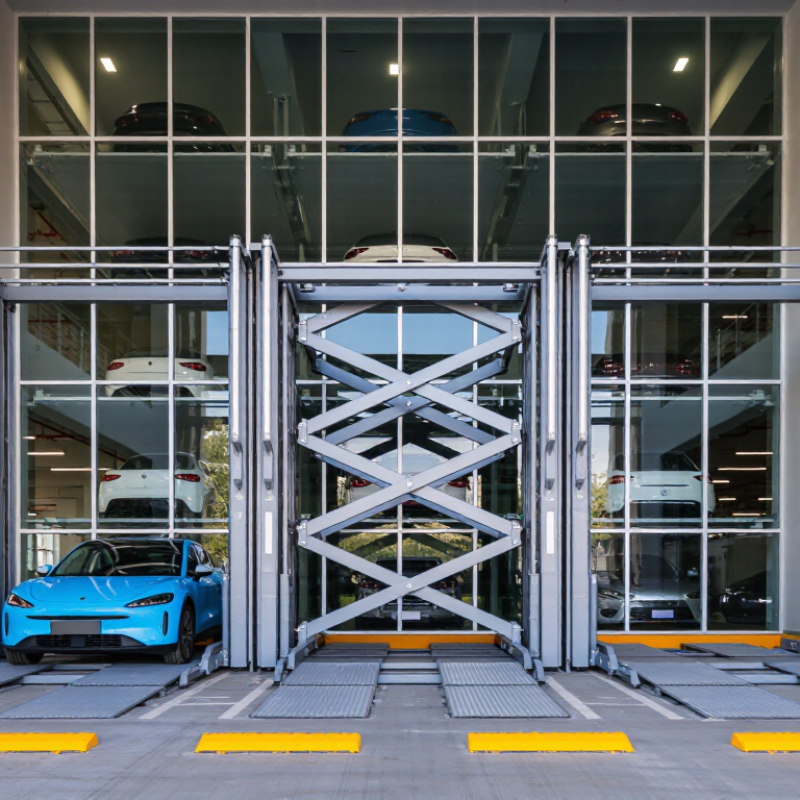
A scissor lift car elevator is a vertical vehicle platform operated by crossing steel arms. Unlike a ramp, it raises a car straight upward using hydraulic cylinders and a reinforced deck. When the arms open, the platform climbs; when they close, it descends. The design is compact. It can fit inside workshops, showrooms, parking structures, or private garages with limited floor space. Some models serve one vehicle, while larger systems handle heavier cars and utility vehicles.
Its frame, locking system, hydraulic unit, and control panel must work together. Mechanical locks support the platform during parking, reducing dependence on hydraulic pressure. A level deck helps technicians position tires, doors, and lifting points accurately. During site evaluation, measure ceiling height, slab strength, vehicle weight, and available approach space. A few centimeters can matter. Real installations often reveal obstacles that drawings miss, such as pipes, drains, or uneven concrete.
Reliable operation depends on trained users, visible safety labels, scheduled inspections, and correctly rated components. Operators should follow the stated load center, clearance, and locking procedures for every lift cycle. Weather exposure also matters when equipment is installed outdoors or in humid regions. Buyers sometimes focus on maximum lifting height and overlook daily access. That is a costly assumption. A practical elevator should match the vehicle, building, workflow, and local installation requirements, not merely promise impressive capacity.
It raises vehicles vertically on a reinforced platform. Crossing steel arms move through hydraulic cylinders. The platform climbs as the arms open. It descends as they close.
It can fit in workshops, showrooms, parking structures, and private garages. Measure ceiling height and approach space carefully. Pipes, drains, and uneven concrete may appear unexpectedly.
Check ceiling height, driveway width, slab strength, vehicle weight, and platform length. Also measure drainage and walking space. Small gaps matter.
Mechanical locks support the platform during parking. They reduce dependence on hydraulic pressure. Operators must confirm lock engagement during every lifting cycle.
Review vehicle-lift standards, machinery risk assessment guidance, and local electrical, fire, and workplace rules. Requirements vary between regions. A certificate alone is not enough.
Test load capacity, lock engagement, emergency lowering, upper-limit switches, grounding, and anti-tilt controls. Inspect anchors and hydraulic lines. Record each result clearly.
Match the elevator to the vehicle, building, workflow, and local installation requirements. Check rated load, platform size, lifting height, clearance, and locking positions. The tallest model may be unnecessary.
Request load charts, engineering drawings, maintenance instructions, test records, warranty terms, and spare-part information. Ask for verified project references. Polished sales language proves little.
Installers may find loose anchors, uneven floors, badly routed cables, or difficult service access. These problems can remain hidden in drawings. Recheck the site after installation.
A Scissor Lift Car Elevator is a space-saving vehicle lifting system designed to raise cars vertically for parking, storage, servicing, or display. Its platform moves through a crossed-arm scissor mechanism powered by hydraulic or electromechanical equipment, allowing smooth lifting and lowering within a prepared pit or above-ground structure. Depending on project needs, buyers may choose compact parking models, heavy-duty service lifts, or customized systems with different platform sizes, lifting capacities, control methods, and weather protections.
For global buyers, safety, installation conditions, and long-term reliability are essential considerations. The selected model should include stable platforms, mechanical locking devices, emergency stop functions, overload protection, and appropriate guard measures. Buyers should also confirm site dimensions, foundation requirements, power supply, drainage, maintenance access, and compliance with applicable local standards. Choosing the best supplier involves evaluating engineering capability, product documentation, customization support, installation guidance, spare-parts availability, warranty terms, and after-sales service. A careful comparison of these factors helps ensure the elevator matches both operational needs and the installation environment.

 Cherish